The Final Stretch
There is a ladder.
The ladder is always there—Adrienne Rich, “Diving into the Wreck”
I have weeks of Vya devlog drafts and will attend to them soon, but this post is about my last two weeks as a graduate student in game design, an experience that concluded with the NYU Game Center Spring Showcase this past Wednesday. There was a graduation ceremony on Friday, but for me, the MFA in Game Design ended on Wednesday, watching people both new and familiar play my game Vya.
Right before the doors opened to the public, my friend Victoria took a picture that captures so precisely how I felt in that moment:
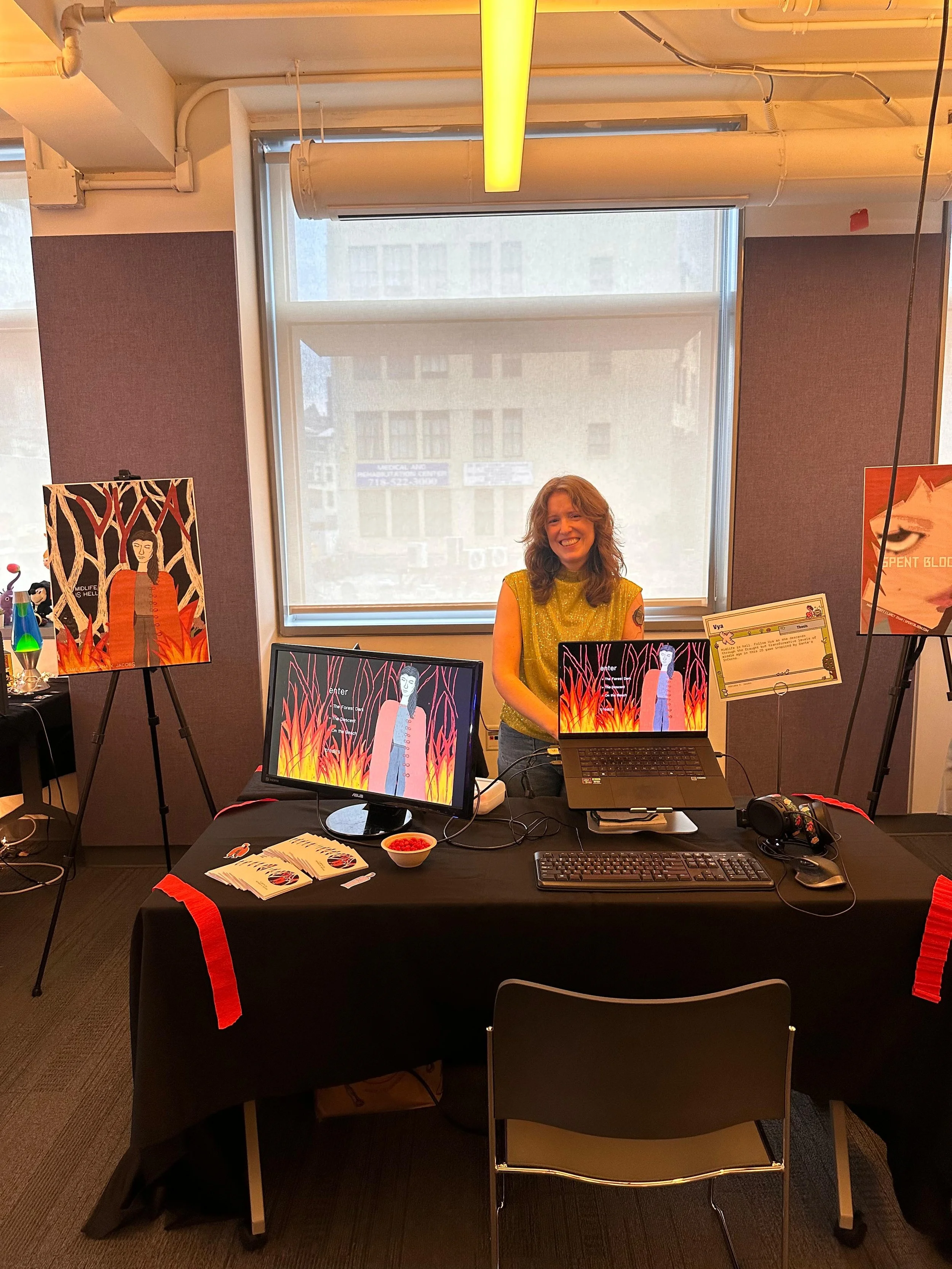
Happy game designer standing in front of her showcase table. Note the artfully placed red streamer and the bowl of Red Hots.
I don’t like to be photographed, but I really love this picture. I see my relief that the monitor I borrowed connected successfully with my laptop, streaming Vya gameplay all night long. I see my amusement for figuring out a use for the yards of red streamer that I had brought from home. I see how my friend puts me at ease in an overwhelming moment. I am either entering or exiting a fit of laughter, but the point is that I am laughing. And above all, I see my unabashed joy and pride in the game that I have made and will continue to develop.
I barely slept these past few weeks. A night owl by nature, going to bed late is not unusual for me, but I pushed myself into vampiric territory towards the end. The truth is that a few weeks ago I already had what I needed for the thesis, but I wanted more—sprites, animations, dialogue, movement. Another level. Voiceovers. A credits scene. A solution to the hideous textboxes in my first level. At this point, I abandoned my tidy production spreadsheet for the increasingly smudged pages of a Blue Book examination booklet, where I recorded the vertiginous chaos of my thesis in this late stage of reformation.
I had made what amounted to the first and last levels of a game that still mostly exists in my head. But when I pictured someone playing Vya at the showcase, I wanted them to have a complete experience. To achieve this I quickly transformed one of my demo scenes into a transitional level that introduces the character of Pom, the psychopomp who guides Vya through Midlife/Hell. In Dante’s Inferno, this character is Virgil, the Roman poet and author of the Aeneid. In Vya, I modeled Pom after the poet Alice Notley, whose Descent of Alette (1996) is one of the great contributions to the literature of katabasis. The game doesn’t work if the player isn’t the tiniest bit invested in Pom. Sure, Pom’s movements are buggy in the showcase build, but these concerns vanished as players expressed fondness for Pom and wanted to take home her sticker (yes, I had stickers!). More importantly, formally introducing Pom, even in such a short scene, contextualizes her appearance in the final chapter, where she literally hands over the “flight controls” to Vya.
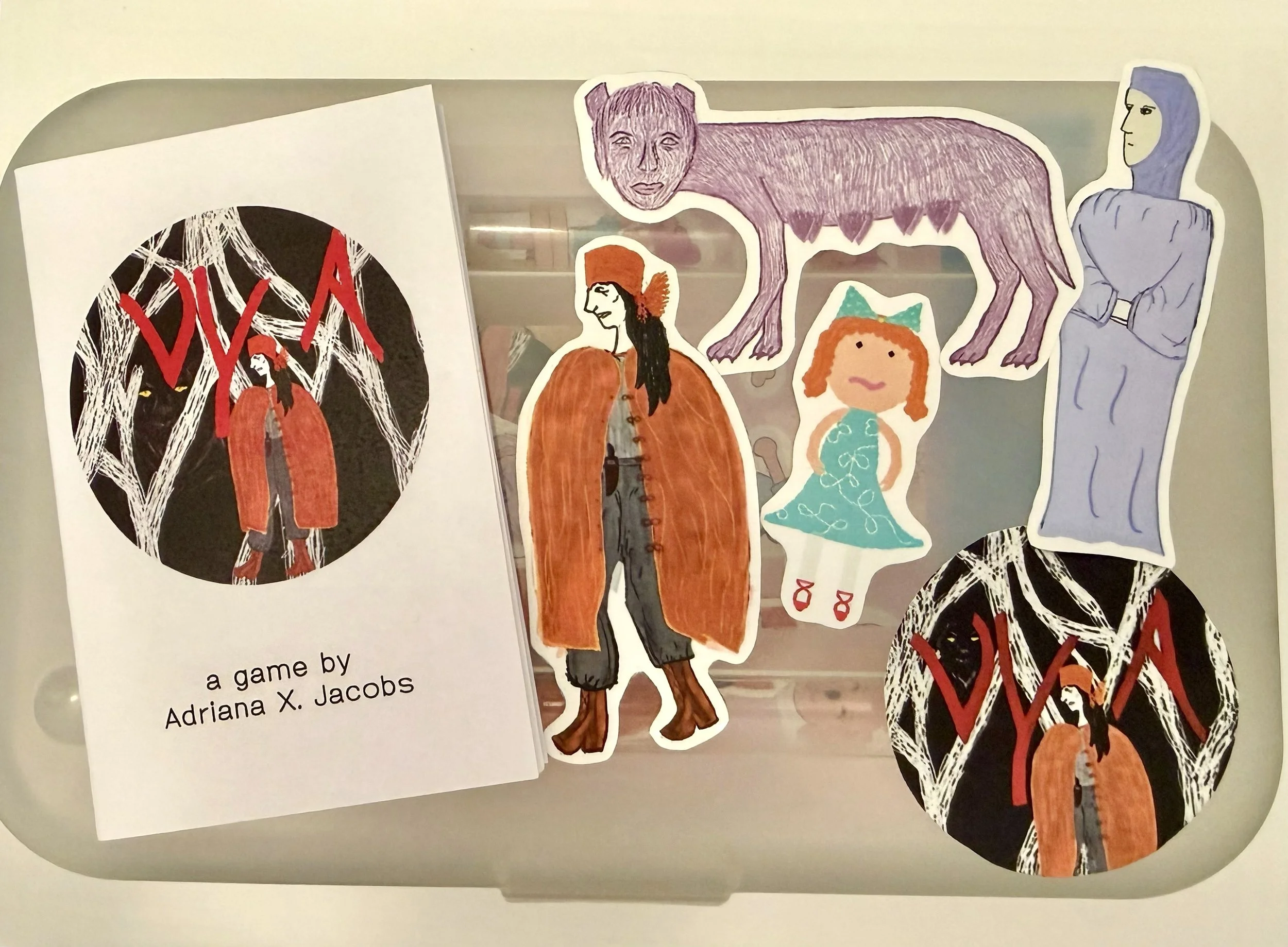
Vya zine and stickers (she-wolf, Vya, ballerina, Pom, game title).
One of the big surprises of this project, indeed of this program, is that I discovered that I really love drawing. For this I have Basil Lim and Winnie Song to thank. Basil’s Visual Lab 0 elective was a required course our first semester, for which we had to produce weekly drawings—putting pen, not pencil, to paper because Basil did not want us fixating on our mistakes. I drew my ballerina doll in this class, for my first physics game, and have put her in many of the games I have made since, including Vya, where she appears as a memory object (and as a sticker). In the spring, I signed up for Winnie Song’s class 2D Art for Games, which gave me the tools and confidence to hand-draw my thesis game. Winnie may read this so I won’t torture her by saying lots of nice things about what a remarkable teacher and thesis advisor she has been, but her directive to “beat the demon” telling me that I wasn’t a visual artist helped break down a stubborn self-image I had carried since childhood.
When people praise my writing, I am gratified but not surprised. I have worn the “skin” of writer most of my life. I know what I am doing when I write. But when people tell me that they like my game’s art style, there is a part of me that can’t believe I pulled it off. And with a Procreate technical pen sized at 10% (on a 2018 iPad no less).
I was told that the showcase atmosphere—crowded, hectic, loud—usually deters people from playing narrative games. But somewhere between 15 to 20 people played Vya, at least two-thirds of them to the end. And many more watched as someone else was playing. A memory I would like to hold forever is the feeling of watching someone play my game from start to finish.
One of these players was my sixteen-year old son, who later shared the most incisive and sensitive observations about my game. In closing, I want to share his thoughts on Vya’s knife, which he compared to the knife in Adrienne Rich’s poem, “Diving into the Wreck,” a poem he studied this year. In both my game and Rich’s poem, the knife appears at the beginning and the end. Vya uses her knife to release the kite and with it her past self (this is my son’s reading). And in the poem, the speaker seeks to cut away the identities, myths, and histories that have kept women submerged and wrecked. I can say with all honesty that I did not have Rich’s poem in mind when I created the knife, but now this poem is part of the game.
As I said in my final thesis presentation: “I want to make a game that relentlessly externalizes a woman’s rage, doubt, and regret. A game that acknowledges what a lifetime of wearing skins for others does to a woman’s skin…I want the player to pay attention when a woman is talking.”
Amid the din of showcase, I am grateful to all of the players who gave Vya their attention.