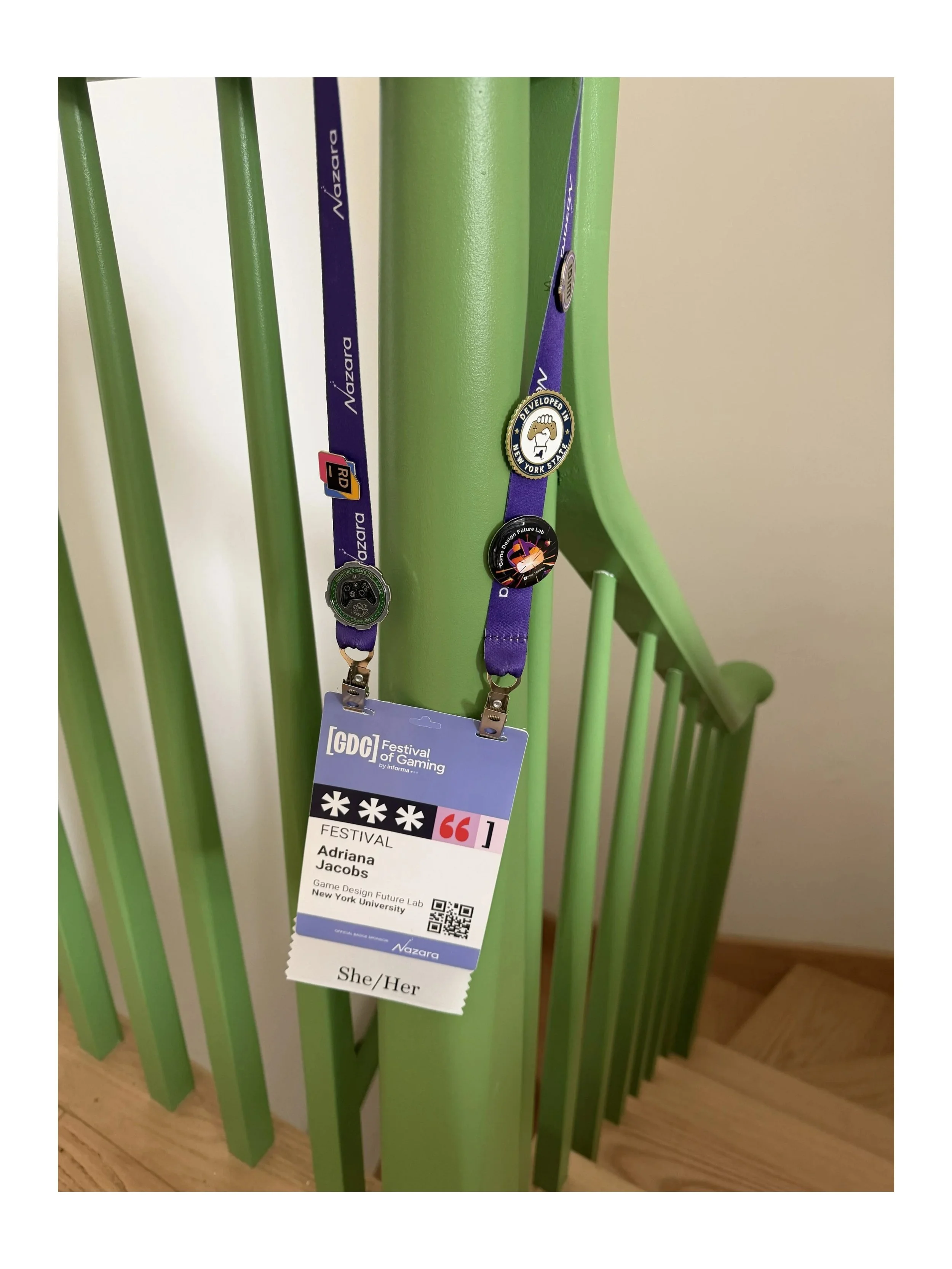
Connect
On my last night at GDC, I was at dinner with some friends from my MFA cohort and we were talking about the exhilarating disorientation and chaos of this conference. How it felt both profoundly tethered to our passions and interests, while also feeling sharply disconnected from the rest of our life. Nico described it as a “fever dream,” and I have not been able to shake off this description.
***
I know that one approach to GDC is to skip the talks and focus on in-person networking, but I really loved the talks and went to several. As a natural introvert, they also allowed me to reset socially, a welcome bonus. Here are some highlights:
The panel “Honing the Blade: Evolving Combat for Ghost of Yotei,” especially when Sucker Punch’s lead combat designer Theodore Fishman was talking about double-edged swords, environmental contexts, and player adaptability. He played an early prototype of the game to demonstrate how the playable character moved through water, a context that positively and negatively affects a player’s approach to combat, the environment itself embodying a metaphorical double-edged sword alongside the literal swords a player can choose to wield. Design and mechanics notwithstanding, and bearing in mind that I have not (yet) played this game, this approach to combat design is very poetic. And I don’t mean “poetic” as in a vague feeling or sentiment, but rather in a formal sense—in the antithetical relation between constraint and context, body and movement, address and response. If this battle moment were a poem, it would be Theodore Roethke’s “My Papa’s Waltz.”
“Performance and Direction Deep Dive” featuring the voice actors Jane Perry and Debra Wilson. Perry voices Selene, the main protagonist of Returnal (Housemarque 2021), a game that continues to inspire my thinking about poetry, translation, and videogames. In fact, I have an article coming out sometime this or next year on translation and videogames that features a long section on Returnal’s Xenoglyphs, mysterious obelisks featuring a language that you can translate with collectible ciphers. Returnal’s narrative designer Eevi Korhonen has a degree in translation studies and has spoken very persuasively about the generative space that translation crosses as it attempts to convey meaning between one language and another. As Selene translates these Xenoglyphs, she learns more about her environment, but the translations also expose her traumatized relation to language. (Oh my god, I love this game!) But back to Jane Perry: it was not my intention to approach her just for the sake of it, but after the panel, we were walking next to each other briefly and it seemed like the right moment to tell her how extraordinary it was to be a middle-aged woman playing a character who is a middle-aged woman voiced by a middle-aged woman. I also squeezed in a question about narrative design and the scout logs, which she graciously answered. She asked about my own work in game design and I told her briefly about Vya and how I want to make games that reflect the experiences of middle-aged women (because, really, such characters shouldn’t be “extraordinary”). “Yes! I fully support you on your journey,” she said. Her words felt like being hugged by those electric blue tendrils in the Overgrown Ruins.
Narrative Portfolio Review was not a talk, but rather an opportunity to have one’s portfolio assessed by a veteran narrative designer. An experience for which I stood in line for 2 hours, listening to a long interview with Rachel Reid and occasionally talking to the people I met in line. I opted for a random selection and drew Aysha U. Farah (Life is Strange, The Sky Left Us, Hiveswap 2). I presented my online portfolio, and Aysha’s feedback was very specific and precise, the kind of feedback that I can implement directly (and will do so very soon…).
Bruce Straley’s (The Last of Us, Uncharted 4, Coven of the Chicken Foot) talk on “fears, failures, and freedoms” will need its own post. It’s the one that resonated with me on a deeply personal, molecular level.
***
A lot of “connecting” happened at GDC. LinkedIn “connects” have replaced the business card (though there were some holdouts). Despite my misgivings about that platform (it’s too much like Facebook), I’m really pleased that most of these “connects” are the result of actual conversations with people, including people who played HEL10S, a game I worked on last year and showcased at the NY State Pavilion. Most of us who attend GDC and make (or want to make) games seek opportunities for visibility, collaboration, and investment, which risks turning every interaction into a potential transaction. When I asked questions or answered a question, I tried to remain anchored to a state of genuine curiosity. When this worked, I also felt very grounded in who I am right now, which hasn’t always been the case in my professional life. At the same time, this has been a period of reconnection with friends from other epochs of my life, as far back as twenty years. In these conversations, I sometimes feel partitioned—who I am now and in this moment ceding space to the self-parts cached in the past, sometimes a very latent, recessed past. If I go back far enough, the present can feel dislocated, unsettled. But there’s also something wondrous about this process, how it reveals the chiastic structure of our lives, with middle age being at the long center of it (if we’re lucky).