On the beach
My resolution to update my devlog weekly fell apart recently due to a bout of doubt. I am going to try to overcome the silence that doubt induces because I think it is very import to be honest about those weeks when game development is not going well. I have practiced this kind of honesty in my academic life, but maybe because game design is such a huge pivot for me, second-guessing and embarrassment muscle their way into any failure or struggle I encounter (and there are many!). “But you’re so good at what you do,” more than one person said to me when I started talking about studying game design. As if it is only permissible to change careers or specializations when you are not excelling at the one you have. Though I sometimes miss being “so good” at something, I don’t miss feeling stagnant. I don’t miss that at all.
Now for this week’s devlog update: Vya is a very “chatty” game, but until two weeks ago, I only had implemented Vya’s interior monologue, for which I relied on my own script and a bunch of colliders that activate textboxes when Vya walks by. It works well, however, for the game’s multiple branching dialogues and NPC background chatter, I am using Yarn Spinner, which is a ridiculously complicated and complex dialogue system. To be fair, most of the available dialogue systems are complicated, so in the end, it comes down to committing to one and persevering. Setting up speech bubbles was tricky, and I still have to customize them to fit my game’s visual style, but once I got them to work, the game’s next level—a nightclub—finally felt doable.
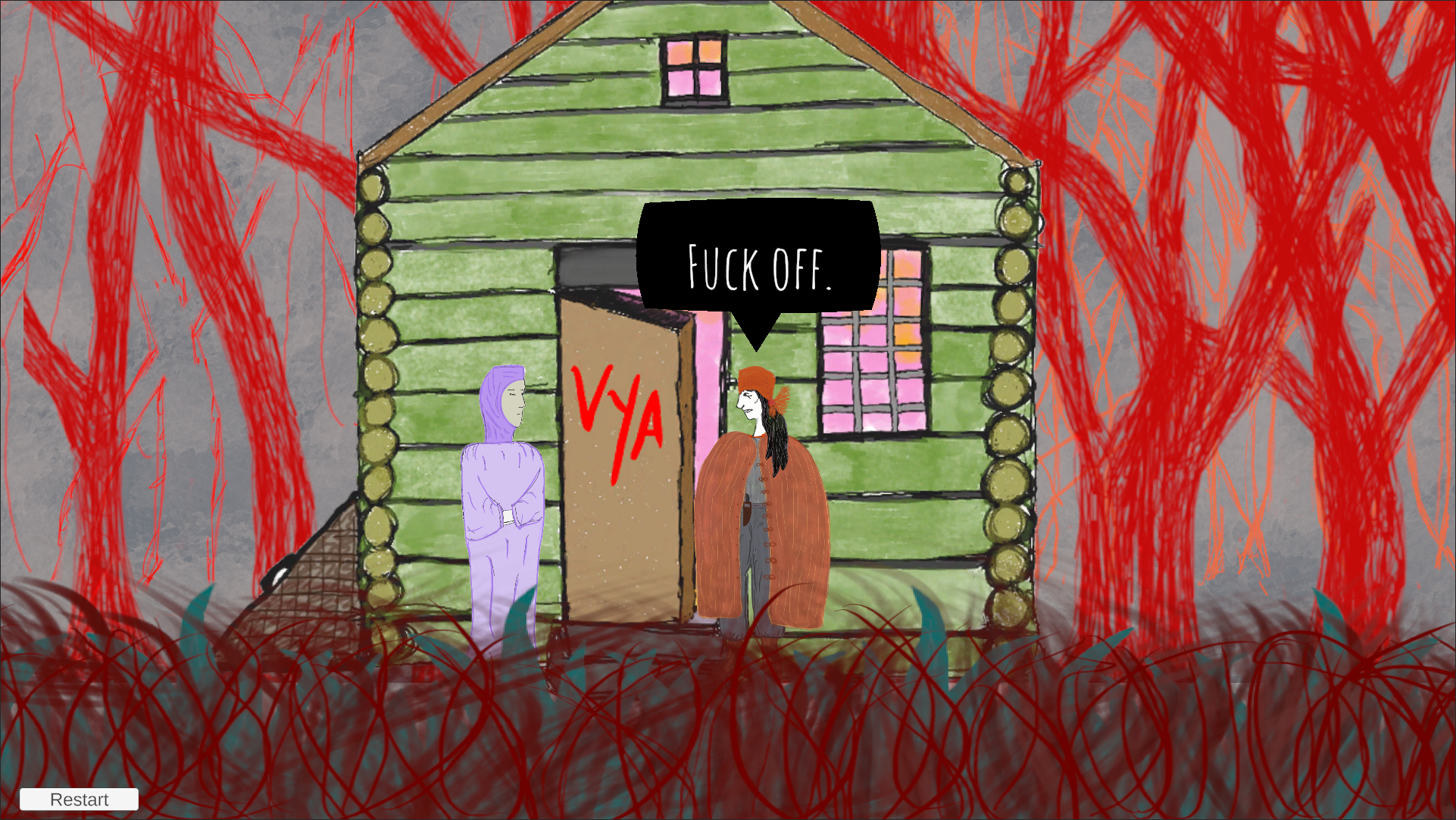
Vya and Pom—Yarn Spinner experiments in my prototype scene.
The nightclub level will correspond loosely to Dante’s Limbo, Hell’s first circle, where the outcasts (pagans, the unbaptized…) wallow eternally. Souls in Limbo do not suffer physical torment; rather, they exist in a state of constant tedium and yearning. When Dante and Virgil walk by, they are eager to talk and share their stories. I can see the entire level in my head—the sprites, the conversations, the critical path, how Pom (my game’s version of Virgil) interacts with the environment, and even the memories that Vya collects there.
A couple of weeks ago I hit a wall—working on a solo project can be really lonely. I miss working on a team, but what I struggled with really was my responsibility for all aspects of the game: art, writing, programming, level design, dialogue implementation, and more. To make this game, I inevitably end up working outside of my comfort zone, and for the past few weeks that zone has been Yarn Spinner.
Feeling unmoored, I took my copies of Alice Notley’s The Descent of Alette and For the Ride to the Game Center last week and spent an entire morning writing on the whiteboards of the small conference room. What emerged was a combination of poetry and dialogue for the game’s penultimate scene, which will take place on a beach. Here Vya and Pom, who reveals herself to be a certain poet, talk about aging, mortality, and the creative life. It is important that this conversation take place on an ocean beach both because I love beaches and because it is a classic liminal space that I associate with self-annihilation, transformation, apocalypse. The place where a vampire tired of immortality meets the sunrise. Or as one classmate put it, “your own Death Stranding.”
At the center of the last circle of Hell, Dante and Virgil find Lucifer encased in ice. Rereading this scene last week, I felt pity for the fallen angel, condemned to an eternity of immobility. So while it can be isolating, one of the gifts of working on a solo thesis project is that I can shift my focus and priorities. A long stretch of writing was the thaw I needed.